Islamic monument · Cairo
Elmoez street
A thousand years of Cairo along one street
- City
- Cairo
- Type
- Islamic monument
- Era
- Fatimid to Ottoman eras, from c. 969 CE
Overview
Al-Muizz Street (Shari' al-Muizz li-Din Allah) is the historic spine of medieval Cairo, running through the walled city founded by the Fatimids in 969 CE. Stretching between the northern gate of Bab al-Futuh and the southern gate of Bab Zuweila, it is often described as an open-air museum of Islamic architecture. Part of Historic Cairo, inscribed on the UNESCO World Heritage List in 1979, the street preserves mosques, madrasas, mausoleums, markets and houses from more than a thousand years of urban life.
The street takes its name from the Fatimid caliph al-Muizz li-Din Allah, who arrived in Egypt in 973 CE after his general Jawhar al-Siqilli had established al-Qahira. In the Fatimid period it served as the main ceremonial road linking the palaces and the city gates. Later the Mamluk sultans, notably Qalawun, al-Nasir Muhammad and Barquq, lined it with grand religious and charitable complexes, while Ottoman patrons added fountains, schools and merchant houses that still shape its character.
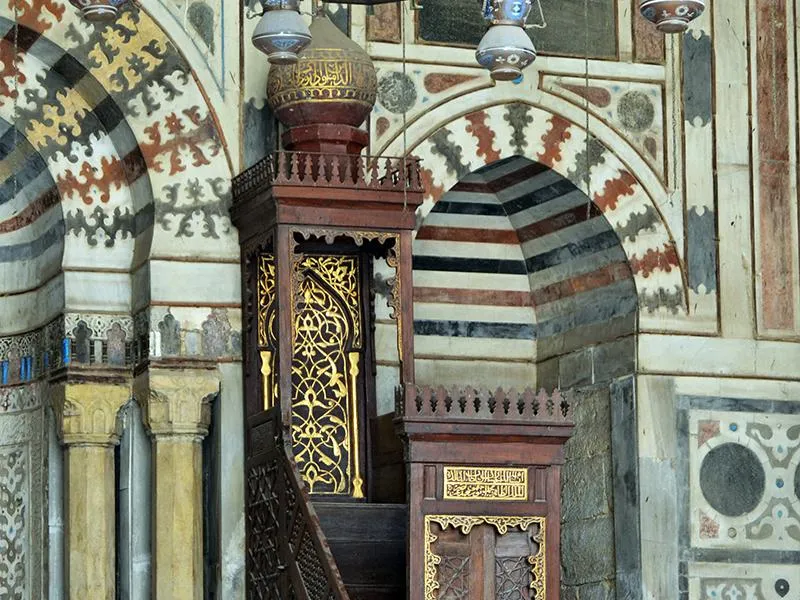
Walking its length offers a layered experience of Cairo's architecture: carved stone façades, towering minarets, deep portals, muqarnas vaults and wooden mashrabiya screens. Many monuments stand shoulder to shoulder, so visitors can move within minutes from a Fatimid mosque to a Mamluk mausoleum and an Ottoman house. The surrounding district remains a living neighbourhood of craftsmen, shops and cafés, and the nearby Khan al-Khalili bazaar and Al-Azhar Mosque make it easy to combine in a single visit.
What to see
- 01Bab al-Futuh and Bab al-Nasr, the monumental Fatimid northern gates built under Badr al-Jamali
- 02The Mamluk cluster around the Qalawun complex, with the neighbouring complexes of an-Nasir Muhammad and Barquq
- 03The richly carved façade of the Fatimid Mosque of al-Aqmar
- 04Bab Zuweila at the southern end, and the Ottoman-era Beit al-Suhaymi house
Visitor tips
- Opening hours and ticket arrangements vary by monument and can change, so confirm details locally or with official sources before your visit.
- Dress modestly with covered shoulders and knees, and be ready to remove your shoes when entering active mosques.
- Visit in the morning or around sunset for cooler temperatures and softer light, and wear comfortable shoes for the uneven paving.
Frequently asked questions
What is Al-Muizz Street famous for?
It is famous for having one of the richest concentrations of medieval Islamic monuments in the world, including Fatimid, Mamluk and Ottoman mosques, madrasas, mausoleums, gates and houses, all within Historic Cairo.
Where does Al-Muizz Street start and end?
The street runs through the old Fatimid city between Bab al-Futuh in the north and Bab Zuweila in the south, close to Al-Azhar Mosque and the Khan al-Khalili bazaar.
How much time should I allow for a visit?
A walk along the street can take a couple of hours, but allow longer if you plan to enter several monuments, climb a minaret or stop at nearby cafés and markets.