Overview
The Gayer-Anderson Museum occupies two adjoining houses of Ottoman-era Cairo, built against the outer wall of the Mosque of Ibn Tulun in the Sayyida Zeinab district. The older house is generally dated to the 16th century and the other to the 17th, and the two were later joined by an upper-level bridge. Often called Bayt al-Kritliyya, the House of the Cretan Woman, the complex is one of the best-preserved examples of a traditional Cairene urban residence.
The museum is named after Robert Grenville Gayer-Anderson, a British army medical officer and passionate collector who spent many years in Egypt. In the 1930s he received permission to restore the houses and live in them, furnishing the rooms with textiles, carpets, woodwork, metalwork and decorative objects gathered from Egypt and far beyond. When he left Egypt in 1942, he gave the house and its contents to the Egyptian state, and it opened to the public as a museum.
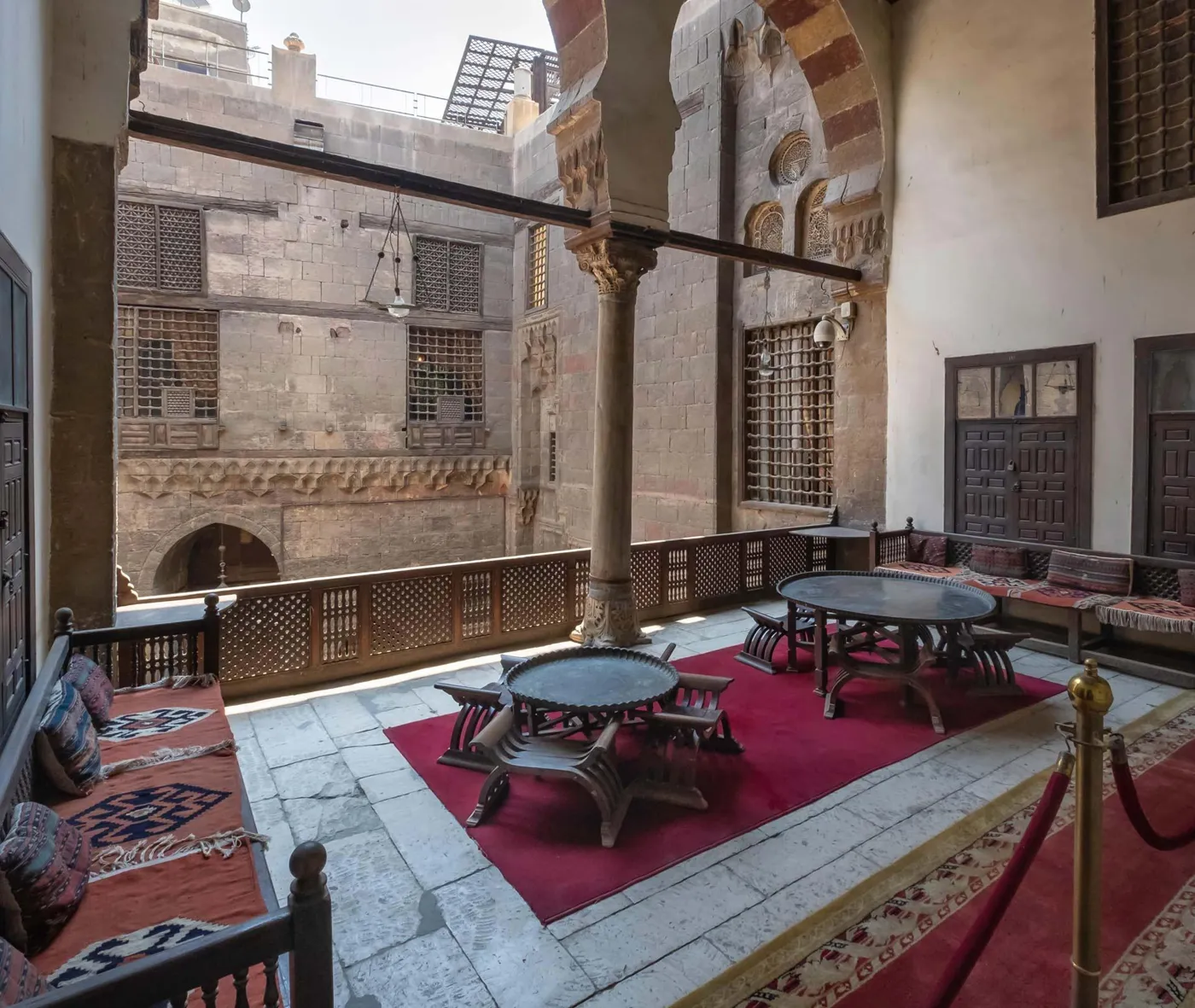
The charm of the visit lies in the architecture as much as in the objects. Rooms open around courtyards and reception halls, with carved wooden mashrabiya screens, painted ceilings, inlaid furniture and a roof terrace overlooking the mosque. Several rooms are arranged in distinct regional styles, giving a vivid sense of domestic life, hospitality and the separation of public and private spaces in historic Cairo. The house also appeared in a 1977 James Bond film.
What to see
- 01The reception hall (qa'a) with its decorated ceiling, fountain and carved woodwork
- 02Intricate mashrabiya screens that let residents see out without being seen
- 03Period rooms furnished in different regional styles, including Persian- and Damascus-inspired interiors
- 04The roof terrace and upper-level bridge linking the two houses, with views toward the Mosque of Ibn Tulun
Visitor tips
- Combine your visit with the neighbouring Mosque of Ibn Tulun, one of Cairo's oldest and most striking mosques, which is only steps away.
- Check current opening hours and ticket details with official sources before you go, as they can change.
- Wear modest, comfortable shoes: the houses have steps, narrow passages and uneven floors, and photography rules may vary by room.
Frequently asked questions
Where is the Gayer-Anderson Museum located?
It is in the Sayyida Zeinab district of Islamic Cairo, built directly against the outer wall of the Mosque of Ibn Tulun.
Why is it called the House of the Cretan Woman?
Bayt al-Kritliyya is the traditional name of the complex, meaning House of the Cretan Woman. The name is linked to a woman from Crete associated with the house in its later history.
Who was Gayer-Anderson?
Robert Grenville Gayer-Anderson was a British army medical officer and collector who restored the houses in the 1930s, furnished them with his collection, and gave them to Egypt when he left in 1942.