Overview
Karnak Temple, known to the ancient Egyptians as Ipet-isut, often translated as the most select of places, is a vast complex of temples, chapels, pylons and obelisks on the east bank of the Nile at Luxor, ancient Thebes. It is among the largest religious sites ever built and served as the principal cult center of the god Amun-Ra. Today visitors walk through a landscape shaped by pharaohs over roughly two thousand years, making it one of Egypt's most important open-air monuments.
Building at Karnak began in the Middle Kingdom and continued through the New Kingdom into the Ptolemaic and Roman periods, with each generation adding to the site. Rulers such as Hatshepsut, Thutmose III, Seti I and Ramesses II raised pylons, halls, obelisks and statues. The complex is divided into several precincts, the largest dedicated to Amun-Ra, with others for the goddess Mut and the god Montu, and a temple of Khonsu within the main enclosure.
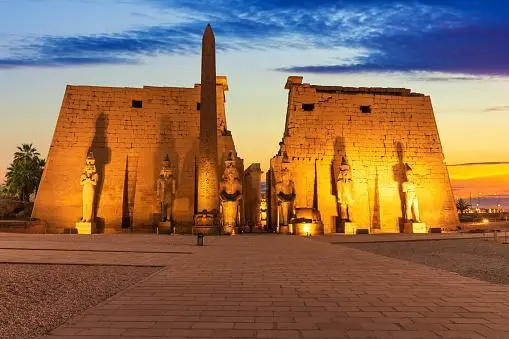
Karnak was linked to Luxor Temple by a ceremonial route lined with sphinxes, used for great religious festivals such as the Opet Festival. In 1979 UNESCO inscribed Karnak as part of the World Heritage site Ancient Thebes with its Necropolis. Today it is an archaeological site open to visitors, where conservation and excavation continue, so the experience of the monument keeps evolving.
What to see
- 01The Great Hypostyle Hall, a forest of 134 massive columns begun under Seti I and completed under Ramesses II.
- 02The obelisk of Hatshepsut, one of the tallest ancient obelisks still standing in Egypt.
- 03The Sacred Lake, where priests purified themselves, with its large granite scarab statue nearby.
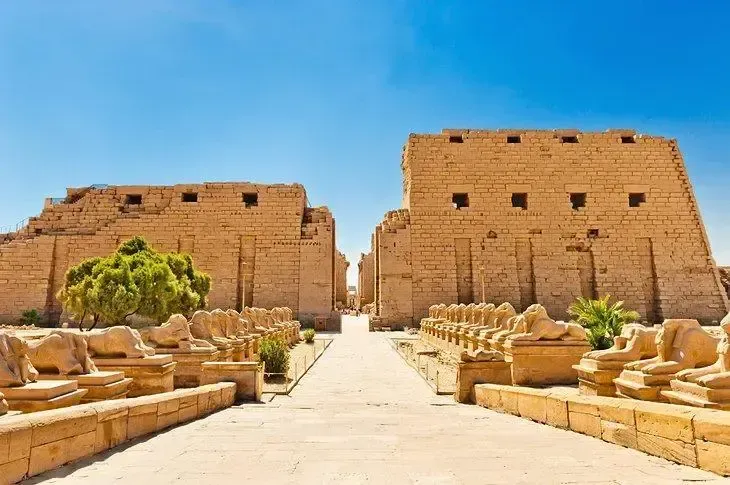
- 04The monumental First Pylon and the ram-headed sphinxes lining the approach to the temple.
Visitor tips
- Arrive early in the morning or late in the afternoon to avoid the midday heat and the largest crowds.
- Wear comfortable walking shoes, a hat and sunscreen, and carry water, as much of the site is open-air with little shade.
- Allow a few hours for the visit and check current opening hours, ticket prices and any evening show details through official sources before you go.
Frequently asked questions
Where is Karnak Temple and why is it important?
Karnak Temple is on the east bank of the Nile in Luxor, ancient Thebes. It was the main center of worship of Amun-Ra and was expanded by many pharaohs over about two thousand years. It is part of the UNESCO World Heritage site Ancient Thebes with its Necropolis.
What is the difference between Karnak Temple and Luxor Temple?
Karnak is a much larger complex made up of several precincts and built over many centuries, while Luxor Temple is a smaller temple in the city center linked to Karnak by the Avenue of Sphinxes. Both were closely tied to the festivals of Amun.
How much time do I need to visit Karnak Temple?
Many visitors spend two to three hours to see the main areas such as the Great Hypostyle Hall, the obelisks and the Sacred Lake. History enthusiasts and photographers may want longer, especially to explore the outer precincts.