Islamic monument · Cairo
Salah Eldin Citadel
Cairo's hilltop fortress of sultans, mosques and panoramic views
- City
- Cairo
- Type
- Islamic monument
- Era
- Medieval Islamic, from 1176 AD (Ayyubid era) to the 19th century
Overview
Salah Eldin Citadel is a medieval Islamic fortress on a spur of the Muqattam Hills, high above Cairo. Construction began in 1176 under Salah al-Din al-Ayyubi, known in the West as Saladin, to strengthen the defenses of the city at a time of Crusader threat. Its elevated site gave the garrison a commanding view over the rooftops, minarets and the Nile valley, and it still offers one of the finest vantage points in the capital.
For roughly seven centuries the Citadel was the seat of government in Egypt. Ayyubid and Mamluk sultans, Ottoman governors and the rulers of Muhammad Ali's dynasty all lived and governed here, each adding new buildings. The Mamluk sultan al-Nasir Muhammad carried out major works in the early 14th century. The court finally moved to Abdeen Palace in the 1870s under Khedive Ismail. The Citadel forms part of Historic Cairo, a UNESCO World Heritage Site.
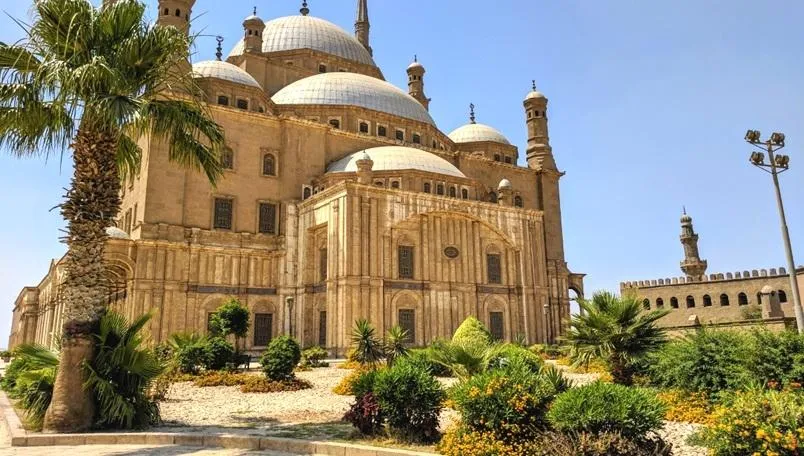
Today the Citadel is a walled complex of mosques, palaces, gates and museums. Its dominant landmark is the Mosque of Muhammad Ali, built in the 19th century in Ottoman style and clad in alabaster, with a large central dome and slender pencil-shaped minarets. Nearby stand the Mosque of al-Nasir Muhammad and the Mosque of Suleiman Pasha, as well as the National Military Museum and other exhibition spaces within the enclosure.
What to see
- 01Mosque of Muhammad Ali (the Alabaster Mosque): a large central dome, a spacious courtyard with an ablution fountain, and the tomb of Muhammad Ali.
- 02Mosque of al-Nasir Muhammad: a 14th-century Mamluk mosque, notable for its minarets and its tall domed prayer hall.
- 03Gawhara Palace and the National Military Museum: former royal buildings of the Muhammad Ali era, now with exhibitions on the Citadel and Egypt's military history.
- 04Panoramic terraces: wide views over Cairo's skyline, Islamic Cairo's minarets and, on clear days, the Giza Plateau.
Visitor tips
- Dress modestly and be ready to remove your shoes before entering the mosques; shoulders and knees should be covered.
- Check the official opening hours and ticket details shortly before your visit, as they can change and some sections may close for restoration.
- Wear comfortable shoes and allow several hours, since the site is large. Late afternoon is pleasant for the views and the softer light.
Frequently asked questions
Who built Salah Eldin Citadel?
Salah al-Din al-Ayyubi (Saladin) began building it in 1176. Later rulers, including the Mamluk sultan al-Nasir Muhammad and Muhammad Ali, added many of the buildings seen today.
Why is the Muhammad Ali Mosque called the Alabaster Mosque?
Its lower walls and courtyard are clad in alabaster. The mosque was built in the 19th century in the Ottoman style and is the best-known landmark of the Citadel.
What is there to see besides the mosques?
The complex also includes royal buildings such as Gawhara Palace, the National Military Museum, historic gates and defensive walls, and terraces with wide views over Cairo.