Archaeological site · Alexandria
Serapeum of Alexandria
Where Alexandria's great god Serapis was once worshipped
- City
- Alexandria
- Era
- Ptolemaic and Roman periods, 3rd century BC – 4th century AD
Overview
The Serapeum of Alexandria was the city's most important sanctuary of Serapis, a Greco-Egyptian god promoted by the Ptolemaic dynasty to bring Greek and Egyptian worshippers together. Founded under Ptolemy III Euergetes in the third century BC, it stood on a rocky rise in Rhakotis, the old Egyptian quarter of the city. Ancient writers counted it among the grandest sanctuaries of the Mediterranean, although very little of its original architecture survives today.
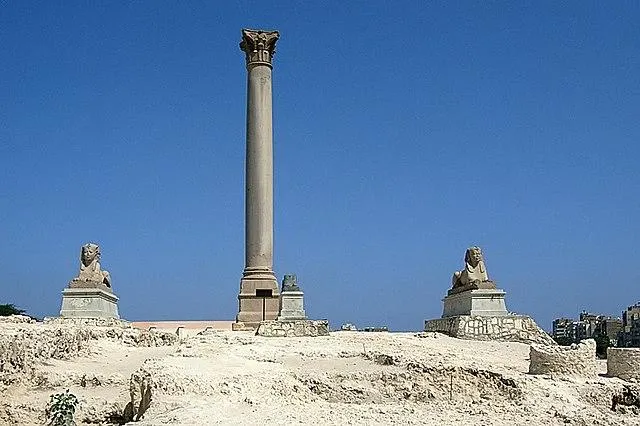
The site is known in Arabic as Amoud el-Sawari and is dominated by "Pompey's Pillar", a single shaft of red Aswan granite about 25 metres high. Despite its popular name, the column has no connection with Pompey. A Greek inscription on its base links it to the Roman emperor Diocletian and dates it to AD 297. It stood within the temple precinct and remains one of the most striking Roman monuments in Egypt.
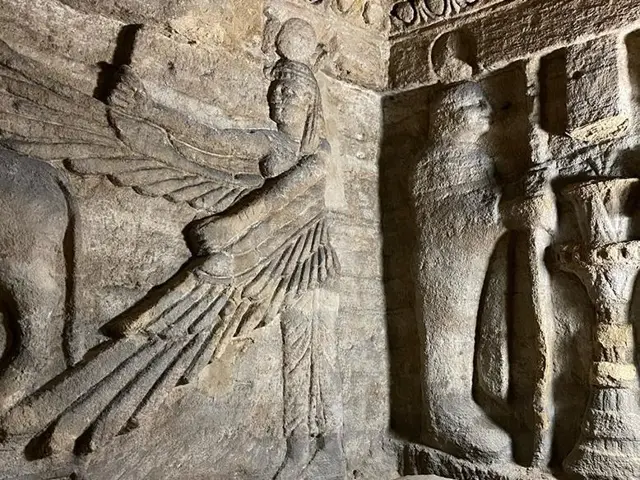
The Serapeum is traditionally said to have been destroyed in the late fourth century AD, when Christian authorities suppressed pagan cult sites in Alexandria. The hill then fell into ruin. Today visitors can see the column, sphinx statues, scattered foundations and rock-cut galleries beneath the ground. Some scholars connect the galleries with the temple's role as a place for storing texts, but this remains debated.
What to see
- 01Pompey's Pillar: the monolithic red granite column of Diocletian's era, about 25 metres high
- 02The sphinx statues standing on the site
- 03The rock-cut underground galleries and niches beneath the hill
- 04The scattered foundations and ruins of the Ptolemaic temple precinct
Visitor tips
- Check current opening hours and ticket details locally or with official sources before your visit, as they can change.
- Bring sun protection and wear comfortable shoes, because the site is open-air with uneven ground and steps.
- Pair the visit with nearby Alexandria sights such as the Catacombs of Kom el-Shoqafa, or with the Graeco-Roman Museum, to understand the city's ancient layers.
Frequently asked questions
Is Pompey's Pillar really connected to Pompey?
No. The name arose from a mistaken medieval tradition. A Greek inscription on the base associates the column with the Roman emperor Diocletian and dates it to AD 297.
What was the Serapeum of Alexandria?
It was the main temple of the god Serapis in Alexandria, founded under Ptolemy III in the third century BC. It was a major religious centre of the city until its destruction in the late fourth century AD.
How tall is Pompey's Pillar and what is it made of?
It rises about 25 metres, including its base and capital, and the shaft is a single piece of red granite from the Aswan region.