Archaeological site · Minya
Amarna
Akhenaten's vanished city of the sun
- City
- Minya
- Era
- New Kingdom, 18th Dynasty, mid-14th century BC
Overview
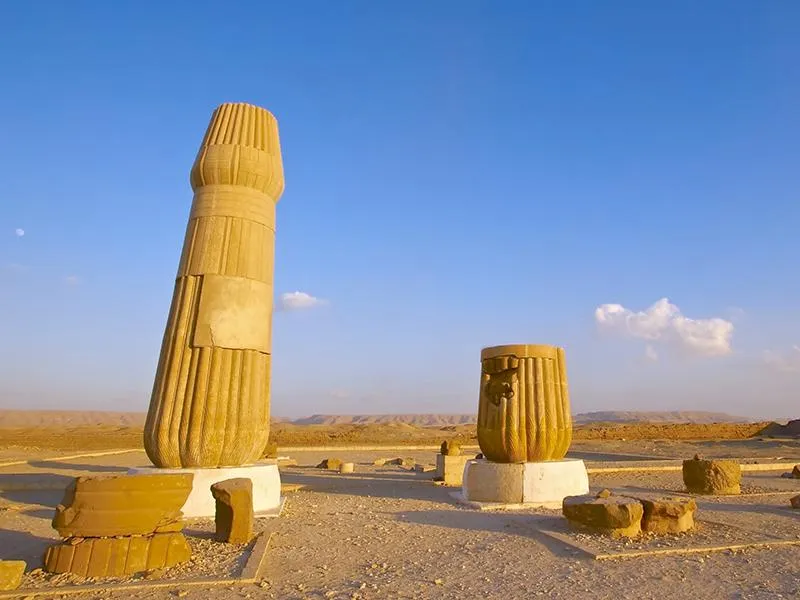
Amarna is the modern name for the remains of Akhetaten, 'Horizon of the Aten', the capital founded by Pharaoh Akhenaten on the east bank of the Nile in what is now Minya governorate. Built around the middle of the 14th century BC on virgin desert land, the city was dedicated to the sun-disc Aten and replaced Thebes as the royal residence. Today the site is a broad desert plain edged by cliffs, where foundations, roads and tombs outline a city planned and built within a remarkably short time.
Akhenaten marked the limits of his city with a series of boundary stelae carved into the cliffs, declaring that the land belonged to the Aten. The city stretched along the river, with a central district of temples and palaces linked by a broad avenue often called the Royal Road, and with residential quarters and workshops around it. Little more than mud-brick and stone foundations survive, but excavations have revealed the layout of the Great Aten Temple, royal and official buildings, and the homes of ordinary inhabitants.
Amarna's fame also rests on its discoveries. A cache of cuneiform clay tablets, known as the Amarna Letters, preserved diplomatic correspondence between Egypt and the rulers of the Near East. In 1912 a German expedition found the painted bust of Nefertiti in a sculptor's workshop; it is now in Berlin. Soon after Akhenaten's reign the court returned to the traditional centres of power and the city was abandoned, leaving a rare and relatively undisturbed snapshot of ancient urban life.
What to see
- 01Rock-cut tombs of Akhenaten's nobles, including the tomb of Ay with its famous Hymn to the Aten
- 02Boundary stelae carved into the cliffs that define the limits of Akhetaten
- 03Foundations of the Great Aten Temple and the Royal Road through the central city
- 04The Royal Tomb in its desert valley and the sweeping views over the ancient city plain
Visitor tips
- Check current access arrangements and which tombs are open before you travel, as conditions at the site can change.
- Hire a licensed local guide: much of the city survives only as foundations, and context makes the site far easier to understand.
- Bring water, sun protection and sturdy shoes, since the site is open desert with little shade.
Frequently asked questions
What is Amarna in Egypt?
Amarna is the archaeological site of Akhetaten, the capital built by Pharaoh Akhenaten in the mid-14th century BC on the Nile's east bank in Minya governorate. It was dedicated to the god Aten and abandoned not long after his reign.
Can I see Nefertiti's bust at Amarna?
No. The painted bust of Nefertiti was discovered at Amarna in 1912 in the workshop of the sculptor Thutmose, but it is now displayed in Berlin. At Amarna you can see the city's remains, tombs and boundary stelae.
Why was Amarna abandoned?
Akhenaten founded the city to serve the worship of the Aten. After his reign the court returned to the traditional capitals and the old religious order was restored, so Akhetaten lost its purpose and was gradually abandoned.