Overview
Medinet Habu is one of the largest and best-preserved temple complexes on the West Bank of Luxor, built as the mortuary temple of Pharaoh Ramesses III, who ruled in the early 20th Dynasty of the New Kingdom. Standing south of the Ramesseum and close to the Colossi of Memnon, the complex was conceived as a "temple of millions of years," where the king's cult would be maintained alongside the worship of the god Amun.
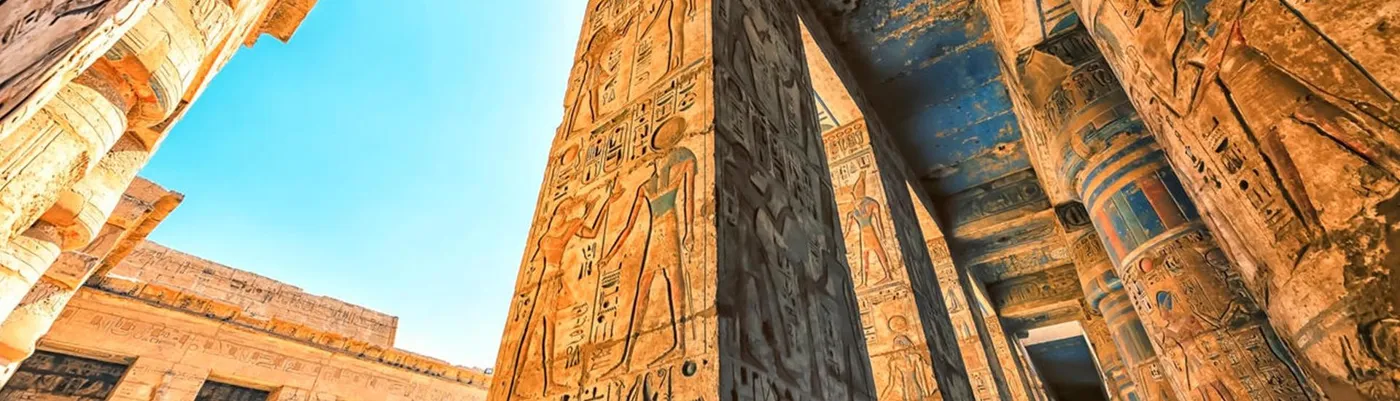
The temple is famous for its enormous wall reliefs, which record Ramesses III's wars against the Libyans and the so-called Sea Peoples, including one of the earliest known depictions of a naval battle. Entry is through the High Gate, a fortified, tower-like structure, leading to successive courts, pillared halls and sanctuaries. Much of the carved surface still preserves traces of its original paint, giving visitors an unusually vivid sense of how Egyptian temples once looked.
The site's story did not end with Ramesses III. Earlier shrines from the 18th Dynasty, associated with Hatshepsut and Thutmose III, stand within the enclosure, and later rulers added to it over many centuries. In the Christian era a village grew inside the walls and parts of the temple were reused as a church. Today Medinet Habu is a rewarding, often quieter alternative to busier Theban monuments, and a key source for studying late New Kingdom history.
What to see
- 01The High Gate, a fortified tower-like entrance unusual among Egyptian temples
- 02Reliefs of Ramesses III's naval and land battles against the Sea Peoples and Libyans
- 03The Second Court, with Osiride pillars and well-preserved painted details
- 04The 18th Dynasty small temple of Amun, linked to Hatshepsut and Thutmose III
Visitor tips
- Visit early in the morning or late afternoon to avoid midday heat, and bring water, a hat and sun protection.
- Check current opening hours and ticket details locally or through official sources before you go, as they can change.
- Combine Medinet Habu with the nearby Colossi of Memnon, the Ramesseum and Deir el-Medina for an efficient West Bank day, and look closely at the upper walls and ceilings for surviving color.
Frequently asked questions
Who built Medinet Habu?
Medinet Habu is chiefly the mortuary temple of Ramesses III of the 20th Dynasty. The enclosure also contains an earlier small temple begun in the 18th Dynasty, and later rulers made additions.
What is Medinet Habu famous for?
It is best known for its large, detailed reliefs showing Ramesses III's victories over the Sea Peoples and Libyans, including a celebrated naval battle scene, as well as its fortified High Gate and well-preserved color.
Where is Medinet Habu and what is nearby?
It lies on the West Bank of Luxor, near the Colossi of Memnon and not far from Deir el-Medina and the Ramesseum. Visitors usually reach it by taxi or organized tour from Luxor.