Overview
The Ramesseum is the mortuary temple of Ramesses II, built on the west bank of the Nile at Thebes, modern Luxor, in the 13th century BC. Dedicated to the god Amun and to the king's own memory, it belonged to the great series of "temples of millions of years" along the desert edge, where royal cults were maintained. Its ancient name is usually translated as the "House of Millions of Years of User-maat-re Setep-en-re", the king's throne name.
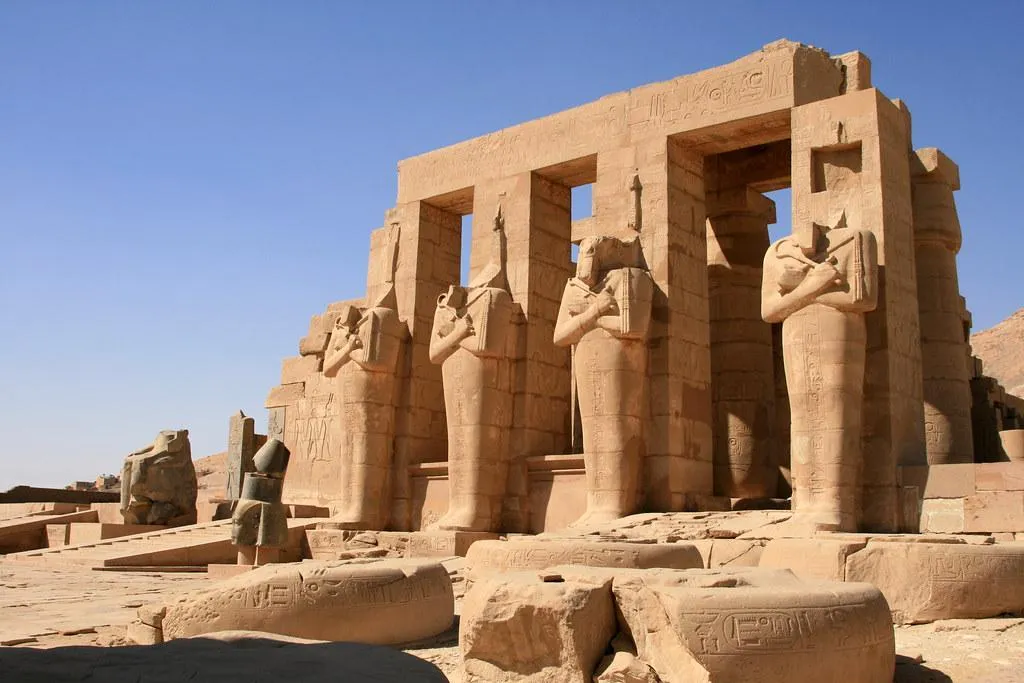
The temple was laid out on a grand axial plan, with two pylons, open courts, a columned hypostyle hall and inner chambers leading toward the sanctuary. Its walls were carved with scenes of the king before the gods and with episodes from his military campaigns, above all the Battle of Kadesh. Much of the stonework is now ruined, yet the plan remains readable, and the surrounding mud-brick storerooms, some with vaulted roofs, show how large the temple's economy once was.
The Ramesseum owes much of its fame to the Greek writer Diodorus Siculus, who described a monument of "Osymandyas", a rendering of the king's throne name. That name reached modern readers through Shelley's poem "Ozymandias". The Ramesseum's name was popularised after Jean-François Champollion visited it in the 1820s. In 1816 Giovanni Belzoni removed a granite bust of Ramesses II from the temple, now in the British Museum.
What to see
- 01The fallen granite colossus of Ramesses II, once among the largest statues in Egypt
- 02Battle of Kadesh reliefs carved on the pylon walls
- 03The hypostyle hall, with its rows of columns and traces of an astronomical ceiling
- 04Osiride statues and the mud-brick storerooms around the temple
Visitor tips
- Visit early in the morning or late in the afternoon for softer light, cooler temperatures and better photographs of the reliefs.
- Combine the Ramesseum with nearby West Bank sites such as Medinet Habu, Deir el-Medina and the Valley of the Kings, and plan the day's order in advance.
- Wear a hat and sturdy shoes, carry water, and check current opening hours and ticket details through official sources before you go.
Frequently asked questions
Who built the Ramesseum and why?
The Ramesseum was built by Ramesses II of the 19th Dynasty as his mortuary temple. It honoured the god Amun and served the king's cult after death, as part of the tradition of "temples of millions of years" at Thebes.
Where is the Ramesseum located?
It lies on the west bank of the Nile at Luxor, within the ancient Theban Necropolis, close to other major sites such as Medinet Habu, Deir el-Medina and the Valley of the Kings.
What is the connection between the Ramesseum and Ozymandias?
"Ozymandias" is a Greek rendering of Ramesses II's throne name, User-maat-re. Diodorus Siculus described a monument of that name, and the Ramesseum's fallen colossus is closely linked with Shelley's poem about a ruined statue and the fading of power.